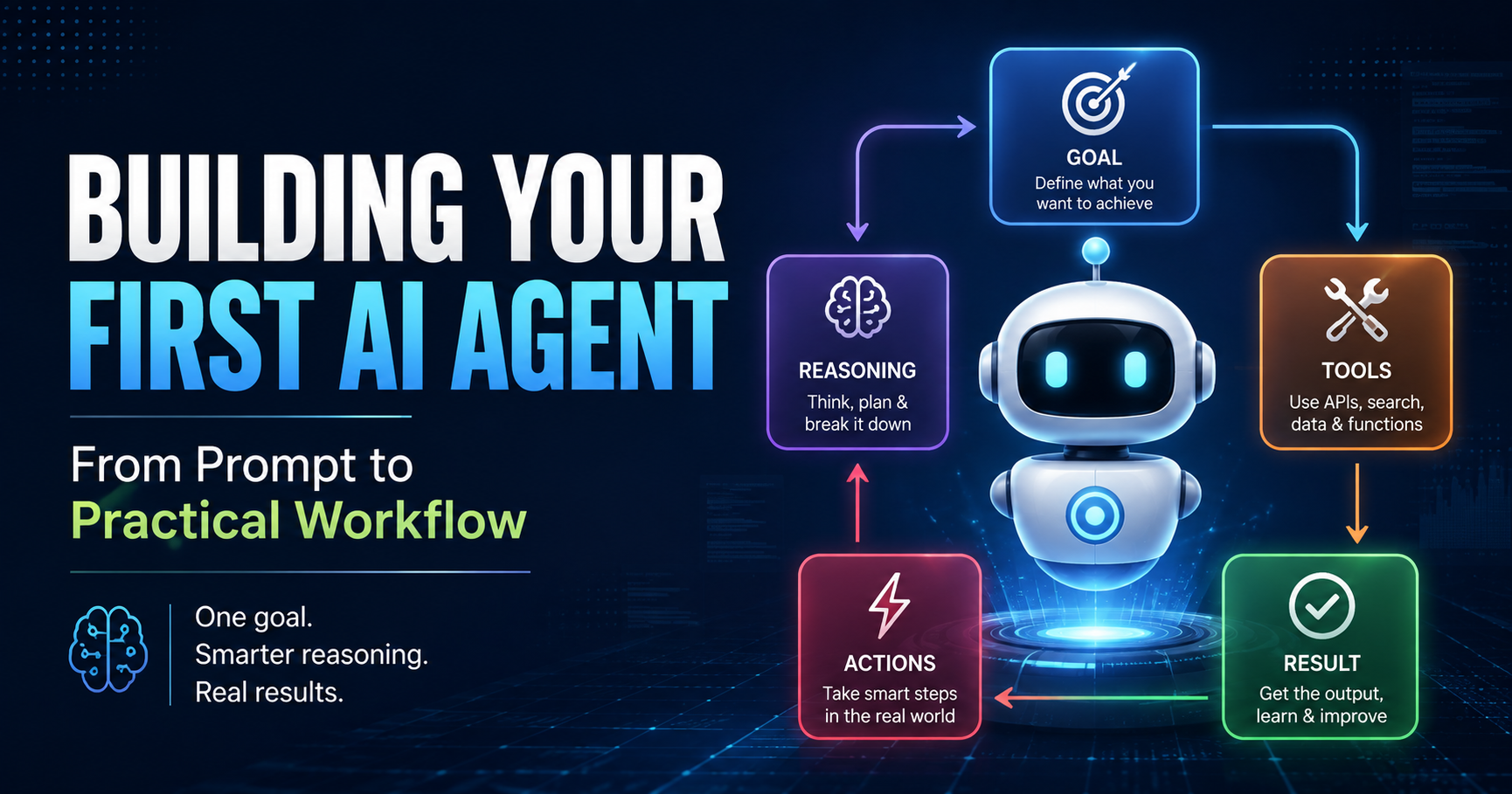
AI agents are quickly becoming one of the most practical applications of generative AI.
But there is an important distinction:
An AI agent is not simply a chatbot with a longer prompt.
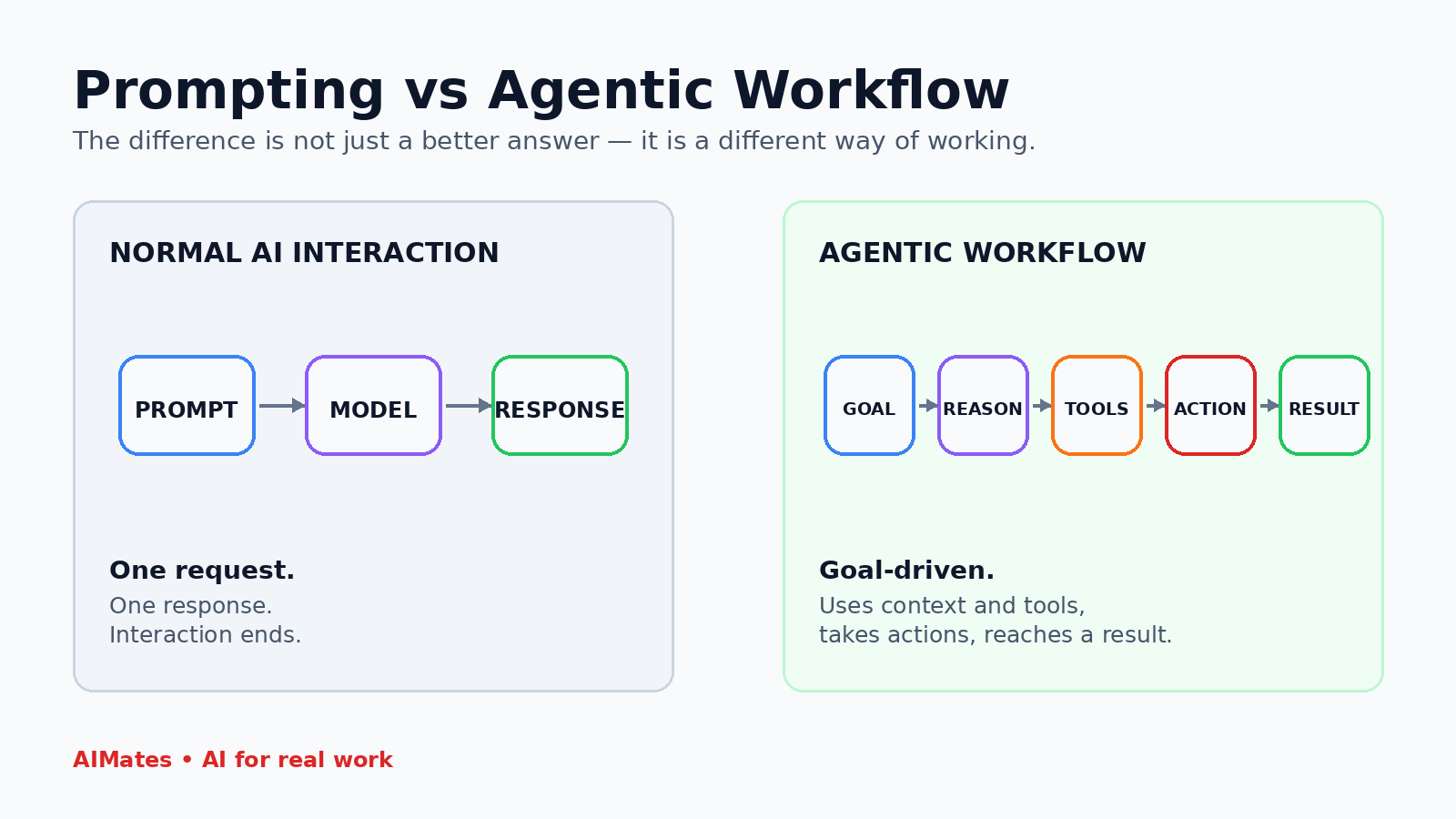
A normal AI interaction often looks like:
Prompt → Model → Response
You ask a question. The model generates an answer. The interaction ends.
An agentic workflow goes further:
Goal → Reasoning → Tools → Actions → Result
Instead of only generating text, the AI becomes part of a workflow. It can decide what needs to happen next, use available tools, maintain relevant context, and work toward completing a goal.
From Prompting to Doing
Imagine we want to build an AI research assistant.
A chatbot might receive:
“Research how AI agents are being used in customer support.”
It could generate a useful response based on the information available to the model.
An AI agent could approach the same request differently:
Receive the research goal.
Break it into smaller questions.
Search relevant information sources.
Analyse and compare the findings.
Identify missing information.
Perform additional research when necessary.
Organise the evidence.
Produce a structured report.
The important difference isn't simply that the second system produces a better answer.
The AI is participating in completing the workflow.
That shift—from generating responses to coordinating actions—is at the heart of agentic AI.
Four Building Blocks of a Practical AI Agent
You don't need a complicated multi-agent architecture to start.
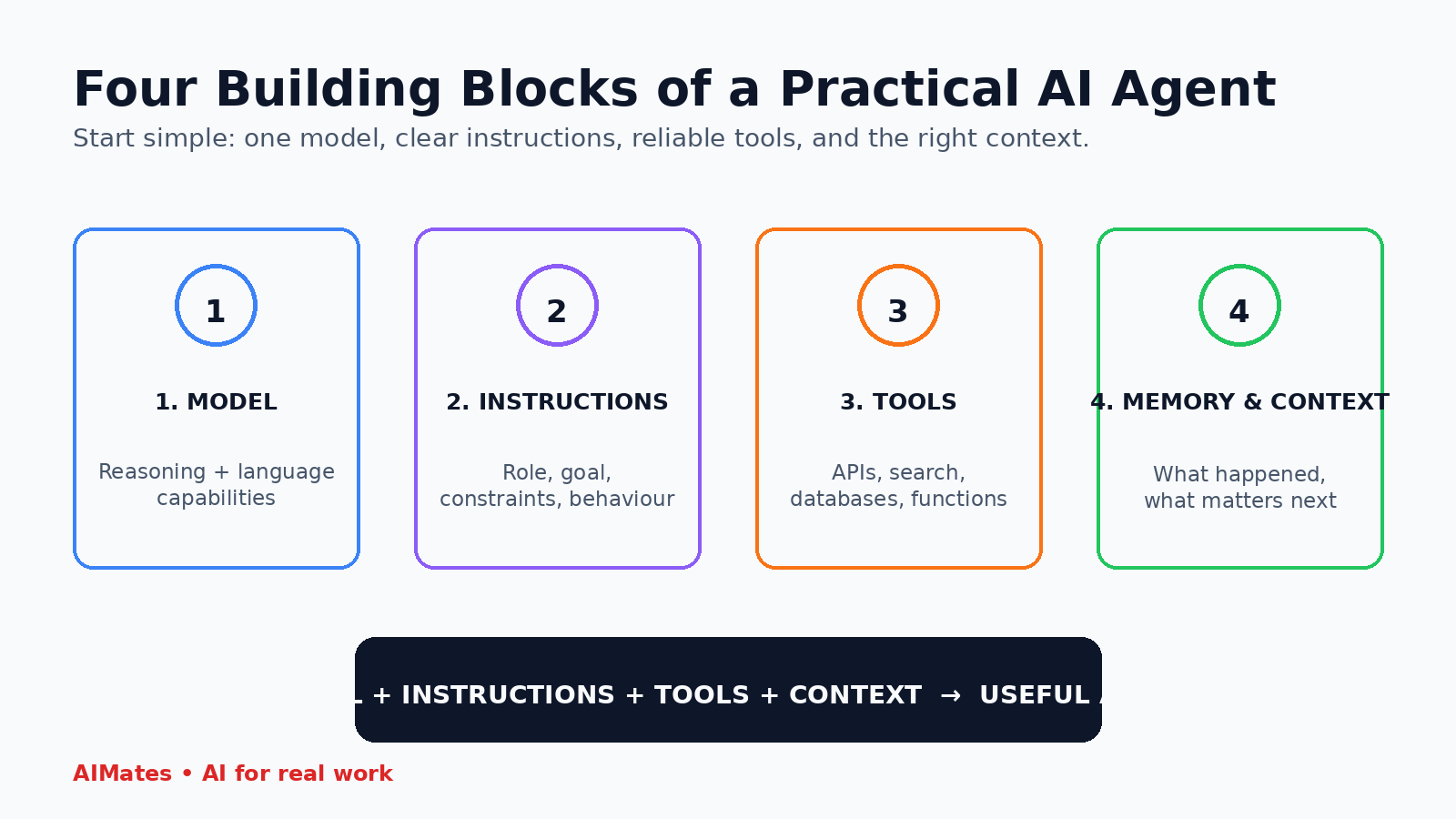
A useful agent can often be understood through four building blocks.
1. Model
The model provides the language and reasoning capabilities of the agent.
It helps understand the goal, interpret information, evaluate possible actions, and determine what should happen next.
In a real system, choosing a model isn't only about intelligence. Reliability, latency, cost and task complexity matter too.
2. Instructions
Instructions define the agent's role, goal, constraints, available tools and expected behaviour.
Good instructions don't just tell an agent what it can do. They establish boundaries around what it should do.
3. Tools
Tools allow the agent to interact with systems outside the language model.
They might include:
APIs
databases
search and retrieval systems
Python functions
files
internal business services
This is where AI starts moving from answering questions toward performing useful work.
4. Memory and Context
An agent needs enough context to understand what has already happened:
What did the user ask?
What has already been attempted?
What information has been collected?
What did the tools return?
What still needs to happen?
But more memory isn't automatically better.
The real challenge is providing the right context at the right time.
The Agent Loop
Many practical agents can be understood through a simple loop:
Observe → Decide → Act → Observe again
The agent examines its current state, decides the next useful action, performs that action through a tool, observes the result, and determines what should happen next.
For our research assistant:
Research Goal
↓
Plan Questions
↓
Search Sources
↓
Inspect Results
↓
Enough information?
↙ Yes No ↘
Build Report Search Again
↓
Final Result
The implementation can become sophisticated, but the underlying idea is surprisingly simple.
Start With a Workflow, Not With an Agent
This may be the most important principle in the article.
Don't begin with:
“I want to build an AI agent. What can I use it for?”
Begin with:
“What workflow or problem am I trying to improve?”
Look for repetitive work, information-heavy tasks, decisions involving multiple sources, or places where software could safely take an action.
Then ask whether an agent is actually the right architecture.
Don't build an agent because agents are popular. Build one because it makes a real workflow better.
Don't Start With Ten Agents
Multi-agent systems are fascinating.
But your first useful AI agent probably doesn't need a digital company where one agent is the CEO, another is the researcher, another is the reviewer, and five others are holding meetings with each other. 😄
Start smaller.
Give one agent one clearly defined problem and a small number of reliable tools.
Make its actions observable.
Test it against real scenarios.
Then add complexity only when the problem genuinely requires it.
A simple system that reliably solves a real problem is more valuable than an impressive architecture diagram that doesn't.
Reliability Matters More Than the Demo
An agent working once in a demo is interesting.
An agent working reliably with real users, unexpected inputs and failing tools is engineering.
Before calling an agent production-ready, ask:
What happens when a tool fails?
What happens when the model selects the wrong tool?
Are tool inputs validated?
Can important actions require human approval?
Can we observe what the agent actually did?
Can the workflow stop safely?
How do we evaluate the final result?
This is where building agents becomes AI engineering, rather than simply prompting a model.
Keep Humans Where They Matter
Autonomy should not automatically be the goal.
For many real-world systems, the best design isn't:
AI does everything.
It's:
AI handles appropriate parts of the workflow while humans retain control over important decisions.
An agent might research information, compare alternatives and prepare a recommendation—but require human approval before sending an email, changing customer data or performing another consequential action.
The right level of autonomy depends on the risk of the task.
Before You Build Your First Agent
Ask six questions:
1. What specific goal will it accomplish?
If the goal isn't clear, the workflow probably isn't ready to automate.
2. What information does it need?
Identify the context and data required.
3. What tools does it need?
Start with the minimum reliable set.
4. What decisions can AI safely make?
Not every decision should be delegated.
5. Where should humans remain involved?
Define approval points before adding autonomy.
6. How will we know whether it worked?
Define success before optimizing the system.
Start Small. Build Something Useful.
AI agents represent an important shift:
From systems designed primarily to answer questions...
to systems capable of participating in workflows.
That creates possibilities across research, software engineering, customer support, operations, data analysis and knowledge work.
But your first agent doesn't need to be revolutionary.
Pick one real workflow.
Give the AI a clear goal.
Connect one or two useful tools.
Keep its actions observable.
Keep humans involved where the risk requires it.
Then test it against reality.
Because ultimately, the most useful question isn't:
“How autonomous is my AI agent?”
It's:
“Did it make the work meaningfully better?”
That is where AI agents become useful for real work.