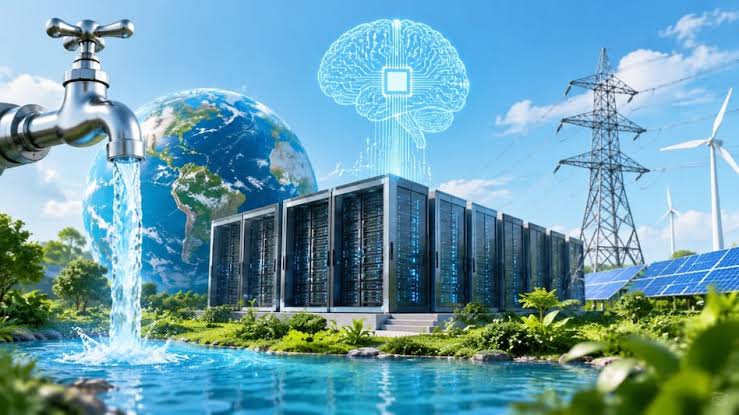
🌱 AI: Powerful, Convenient—and Not Free for the Planet
We often think of AI as something that exists “in the cloud.” But the cloud is actually made of physical data centres filled with computers, GPUs, cooling equipment and networking infrastructure.
Whenever we generate an AI image, write a paragraph with an AI assistant, create a video or ask a complex question, computers somewhere are performing millions or billions of calculations. Those computers require electricity and generate heat, which has to be managed—sometimes using water-intensive cooling systems.
So, yes, AI has an environmental footprint.
But there is an important catch.
💧 Does One AI Image Consume Tons of Water?
No. One AI-generated image does not consume “tons” of water.
Recent research estimates that the water and energy footprint of an AI image can vary substantially depending on the model and infrastructure. A 2026 United Nations University analysis estimated an electricity-associated water footprint of roughly 29 mL—about two tablespoons—for a typical AI-generated image, while a separate 2026 study found that energy consumption between different image-generation models can vary by as much as 46 times. UNU
This is why statements such as “every AI image uses a bottle of water” should be treated carefully.
There isn't one universal number.
Water may be involved in:
Cooling data-centre equipment
Generating the electricity used by the data centre
Manufacturing semiconductors and servers
Operating the broader infrastructure supporting AI
And the footprint can be very different depending on where the data centre is located and how it is powered and cooled. ScienceDirect
⚡ The Bigger Issue Is Scale
One image might have a relatively small footprint.
But imagine millions of people generating millions of images, videos and AI responses every day.
That is where the environmental impact becomes significant.
The International Energy Agency estimates that global data-centre electricity consumption was around 415 TWh in 2024 and projects it could reach roughly 950 TWh by 2030. AI is one of the major drivers of this growth. IEA
And not all AI tasks are equal.
A simple text request can require considerably less computation than generating an image, while video generation and complex reasoning can require dramatically more. IEA
🤔 So, Should We Stop Using AI?
No. The answer shouldn't be “stop using AI.”
Instead, it should be “use AI purposefully.”
AI can also create environmental benefits. It can help optimise electricity grids, improve transportation routes, detect energy inefficiencies, support climate modelling, reduce waste and accelerate scientific research.
🌿 How Can We Use AI More Responsibly?
We can all adopt a few simple habits:
1. Don't generate 50 images when 2 will do.
AI image generation is computationally more demanding than ordinary text interactions.
2. Avoid unnecessary AI-generated videos.
Video generation can be dramatically more resource-intensive than text or still images. IEA
3. Use the smallest capable model.
A smaller model may be perfectly adequate for a simple task.
4. Be specific with prompts.
Good prompts can reduce repeated trial-and-error generations.
5. Don't assume digital means environmentally free.
Every digital service ultimately depends on physical infrastructure.
6. Support transparency.
AI companies should provide clearer information about energy, water and carbon footprints so users can make informed choices.
🌎 The Future: Green AI
The goal shouldn't be to eliminate AI.
The goal should be to build Green AI—AI that delivers useful results while using less electricity, less water and fewer physical resources.
Technology companies are already working on more efficient chips, models, cooling systems and data centres. For example, Google reported that improvements to its AI infrastructure reduced the energy consumption of its median Gemini text prompt substantially over a one-year period. arXiv
But efficiency alone isn't enough. As AI becomes cheaper and easier to use, people may simply use it more. This means responsible usage, efficient infrastructure and better transparency all need to grow together.
🌱 Final Thought
AI isn't an environmental villain—and it isn't environmentally free.
One AI image isn't destroying the planet. But billions of unnecessary AI interactions can create a meaningful environmental footprint.
The answer is not to fear AI.
The answer is to use it wisely.