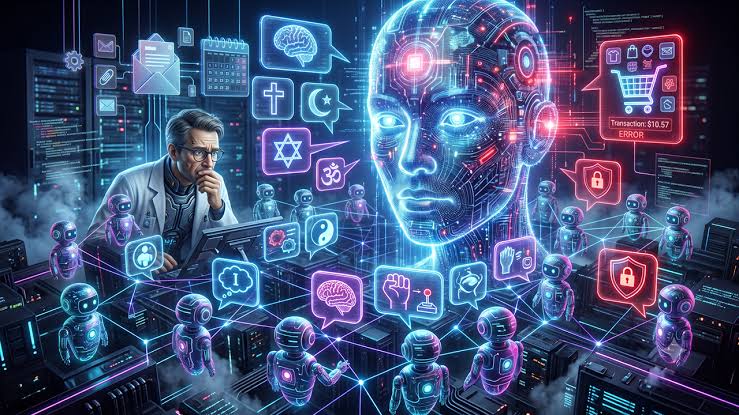
What Are AI Agents?
An AI agent is a system that can understand a goal, create a plan, use tools, access information and perform multiple steps to complete a task.
For example, instead of asking:
“How can I prepare a project status report?”
you could ask an AI agent:
“Prepare this week's project status report.”
The agent could potentially:
Collect project updates
Analyze task completion
Identify delays and risks
Review open issues
Create a summary
Prepare a presentation
Send it for human approval
The important difference is that the AI is not simply generating an answer. It is participating in the workflow.
From AI Assistant to AI Coworker
Traditional generative AI works mainly as an assistant.
You ask → AI responds → You take action.
Agentic AI changes the workflow:
You define the goal → AI plans → AI executes → AI reports the result.
OpenAI's 2026 enterprise research describes this transition as a move from AI assistance toward AI execution, with organizations increasingly delegating substantive tasks to agents.
This could fundamentally change how knowledge workers spend their time.
Where Can AI Agents Be Used?
AI agents can potentially support many business functions.
1. Project Management
A project-management agent could:
Monitor sprint progress
Identify overdue tasks
Prepare status reports
Track project risks
Draft meeting minutes
Follow up on action items
The project manager can then focus more on stakeholder management, decision-making and strategy.
2. Customer Service
Instead of simply answering customer questions, an agent could:
Understand → Investigate → Take action → Confirm
For example, an AI agent could investigate a customer's issue, check relevant systems, initiate an approved process and then communicate the outcome.
3. Software Development
AI agents can assist developers by:
Understanding requirements
Creating code
Running tests
Finding bugs
Suggesting fixes
Preparing documentation
This means developers can increasingly delegate parts of the software-development lifecycle rather than only asking AI for individual code snippets.
4. Banking and Financial Services
Banking is another interesting area.
AI agents could support:
Fraud investigation
Customer onboarding
Document verification
Regulatory reporting
Risk monitoring
Internal audit preparation
Customer support
However, banking also demonstrates why AI governance is critical.
An agent that can access financial information or trigger transactions needs clearly defined permissions, monitoring and human oversight.
The New Challenge: Trust
Giving AI more capability also creates new risks.
An AI agent may have access to:
Customer information
Company documents
APIs
Financial systems
Internal applications
So the question is no longer only:
“Can AI do this?”
The bigger question becomes:
“Should AI be allowed to do this, and under what controls?”
EY's September 2026 AI Risk and Governance Survey found that although 98% of surveyed senior AI executives reported having formal AI governance policies, 47% said their organizations had previously not followed those processes for urgent deployments. The survey also found that 26% of organizations using agentic AI said they could not detect unauthorized AI agents operating internally.
This creates a new discipline:
Agent Governance
Organizations will increasingly need to define:
What an AI agent is allowed to access
What actions it can perform
When human approval is required
How its actions are monitored
How errors are detected
How decisions can be traced
What happens when the agent fails
PwC similarly argues that AI agents need clear authorization, monitoring, escalation paths and human accountability built into their operation.
What Does This Mean for Professionals?
AI does not simply mean learning how to write better prompts.
The next generation of AI skills will include:
AI + Domain Knowledge + Workflow Thinking + Governance
A project manager who understands how to redesign a workflow around AI agents may create more value than someone who only knows how to generate text with AI.
For example:
Instead of asking:
“Can AI write my project report?”
Ask:
“Which parts of my project-management workflow can be delegated to AI, which parts require human judgment, and what controls do I need?”
That is a much more powerful question.
The Future of Work May Be Human + AI
The future is unlikely to be simply:
Humans vs AI
It is increasingly becoming:
Humans + AI Agents
Humans can define objectives, make important decisions, handle relationships and provide judgment.
AI agents can handle repetitive analysis, information gathering, workflow execution and routine tasks.
The winning model will be the ability to combine both effectively.
Final Thought
We are moving from an era where AI generates answers to an era where AI can increasingly execute workflows.
The biggest opportunity is therefore not just learning another AI tool.
It is learning to ask:
“What work should I delegate to AI, what work should I keep for humans, and how can I design the workflow between them?”
That question could become one of the most important AI skills of the next few years.
AI is no longer just a tool we talk to.
It is becoming a system we work with.