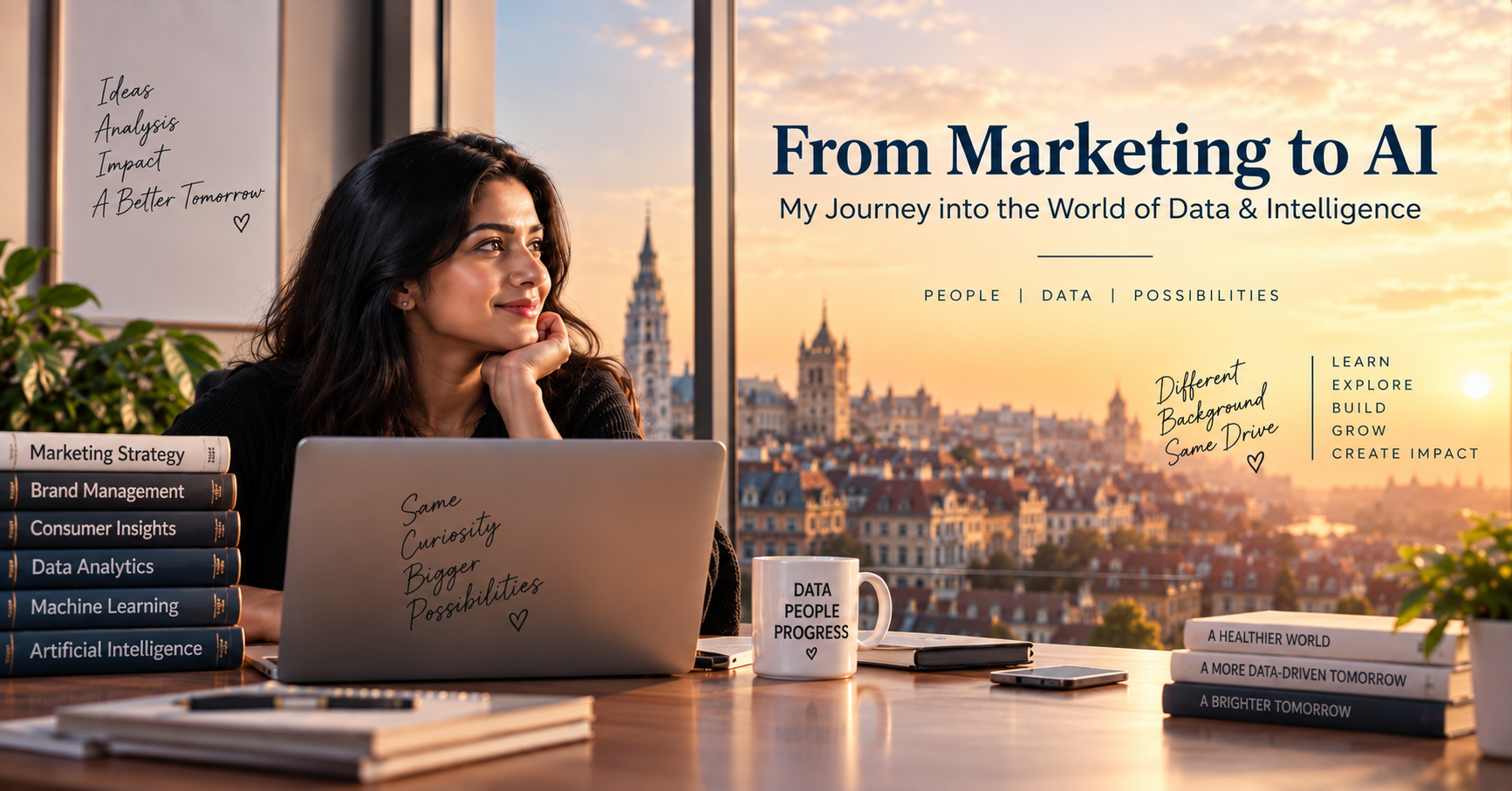
If someone had told me a few years ago that I would be building machine-learning models, working with Python and SQL, creating Power BI dashboards, and developing an end-to-end forecasting application, I probably would not have imagined it.
My professional journey did not begin in data or AI.
I studied Pharmacy and later completed an MBA. I then worked in client relationship management and pharmaceutical product management. My work involved understanding markets, tracking performance, being a brand custodian, looking at sales trends, working with different stakeholders and supporting business decisions.
Looking back, however, there was already one common thread running through much of what I enjoyed doing:
data.
I was interested not just in what happened in the business, but why it happened.
Why did one product perform better than another?
Why did sales change during a particular period?
Which indicators could help us make a better decision?
At that time, I was using data primarily from a business perspective. I didn't yet realize that these questions would eventually lead me toward data analytics, machine learning and AI.
Starting Again as a Learner
Moving into data science meant entering an unfamiliar territory.
I had business experience, but suddenly I was learning Python, SQL, statistics, machine learning, data visualization and concepts that were completely different from what I had studied earlier.
There were moments when even relatively simple technical problems took much longer than I expected. But gradually, something changed. Instead of looking at a dataset as rows and columns, I started asking questions:
What is the data telling me?
What patterns are hidden here?
Can I predict what might happen next?
And most importantly, how can this analysis help someone make a better decision?
That last question became particularly important to me because it connected my previous business experience with my new technical skills.
Moving from Learning to Building
My Data Science studies gave me an opportunity to develop a stronger foundation in analytics and machine learning.
I worked on projects and each project taught me something different.
Some taught me how important data preparation is. Others taught me that a model with impressive metrics isn't necessarily useful unless its results can be understood and applied.
Eventually, I wanted to go beyond building a model in a notebook.
I wanted to understand what an end-to-end data solution actually looked like.
That became one of the most important stages of my learning journey.
What AI Means to Me Now
One of the biggest changes in my thinking has been how I understand AI itself.
When I started, AI seemed like a collection of complex algorithms and technologies that I needed to master.
Today, I see it differently.
The algorithm is only one part of the solution.
You need good data. You need to understand the problem. You need to know what the business actually needs. You need to evaluate whether the output is meaningful. And finally, you need to communicate the result in a way that someone can actually use.
My previous career therefore wasn't something I had to leave behind completely.
It became part of the skills I bring to data and AI.
Understanding stakeholders, asking business questions, communicating ideas and thinking about the practical impact of a solution are skills that remain valuable even when the tools change.
The Challenge of Changing Careers
Career transitions can sometimes look very straightforward when summarized on LinkedIn:
Course → Skills → Projects → New Career.
The reality is much less linear.
There are periods of uncertainty. There is the courage it takes to begin again, to take the first step toward something new. There are technologies you don't understand at first. There are errors that take hours to solve and concepts that seem obvious only after you finally understand them.
And there is always something new to learn.
But I've also learned that you don't need to know everything before you start building.
Projects became one of the most effective ways for me to learn because they forced me to connect concepts rather than study them independently.
Python connected with data analysis.
Data analysis connected with visualization.
Machine learning connected with forecasting.
Forecasting connected with business decisions.
And eventually, all of those connected with application development.
Where I Am Today
I am still learning - and I think that will always be part of working in AI and data.
My focus today is on continuing to grow in the world of data and AI, exploring how technology can turn complex information into meaningful insights and practical solutions.
The transition has also changed how I think about my career. I no longer see my background in business and my newer technical skills as two separate paths. I see the intersection between them as the opportunity. Because ultimately, the value of data isn't simply in collecting more of it, and the value of AI isn't simply in building more sophisticated models.
The real value comes from turning data into understanding - and understanding into better decisions.
And for me, that journey is only beginning.....