If you are starting in Computer Vision, don't begin with the latest model.
Start with why each model was introduced.
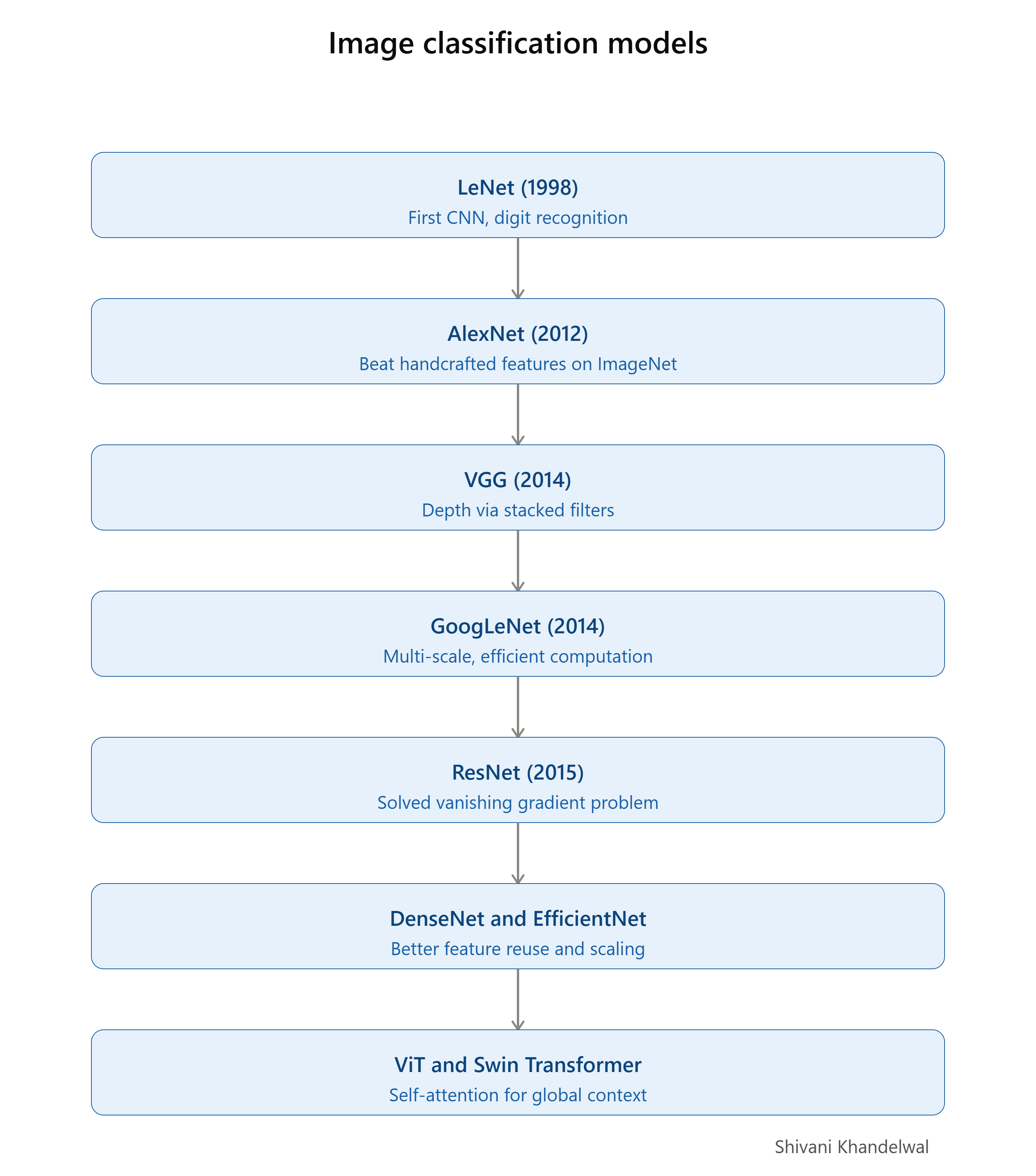
Here's how image understanding evolved over the years:
➡️ LeNet (1998)
The first successful CNN, designed for handwritten digit recognition. It showed that neural networks could learn visual features automatically.
Paper: http://yann.lecun.com/exdb/publis/pdf/lecun-98.pdf
➡️ AlexNet (2012)
A breakthrough on ImageNet that proved deep learning could outperform handcrafted features. It also popularized GPU training.
Paper: https://papers.nips.cc/paper_files/paper/2012/hash/c399862d3b9d6b76c8436e924a68c45b-Abstract.html
➡️ VGG (2014)
Showed that deeper networks could learn richer visual representations using a simple architecture.
Paper: https://arxiv.org/abs/1409.1556
➡️ GoogLeNet / Inception (2014)
Introduced multi-scale feature extraction while keeping computation efficient.
Paper: https://arxiv.org/abs/1409.4842
➡️ ResNet (2015)
Solved the vanishing gradient problem using residual connections, making very deep networks practical.
Paper: https://arxiv.org/abs/1512.03385
➡️ DenseNet & EfficientNet
Focused on better feature reuse and smarter model scaling.
DenseNet: https://arxiv.org/abs/1608.06993
EfficientNet: https://arxiv.org/abs/1905.11946
➡️ Vision Transformers (ViT) & Swin Transformer
Brought self-attention into vision, enabling better global context and becoming the foundation of many modern vision models.
ViT: https://arxiv.org/abs/2010.11929
Swin: https://arxiv.org/abs/2103.14030
Every architecture wasn't just "better"; it solved a limitation of the previous one.