
Reading time: 6 min | Tags: AI Security, Autonomous Agents, LLMOps, Protocol Design
Introduction: The Illusion of "System Instruction" Security
As autonomous AI agents shift from read-only chatbot assistants to actionable software runtimes, engineering teams are encountering an uncomfortable reality: Prompting is not an access control list (ACL).
In early pilot architectures, teams frequently rely on system prompt guardrails such as:
"You are an enterprise support agent. You may query the database for customer orders,
but you must NEVER access payment credentials, drop tables, or call external APIs."
While this feels intuitive in developer sandbox environments, in production environments it represents a fundamental category error. Treating English instructions (or negative constraints) as an authorization policy conflates intent alignment with hard runtime boundaries.
Indirect prompt injection, adversarial semantic ambiguity, and long-context hallucinations continuously prove that an LLM’s stochastic nature will eventually bypass prompt-level restrictions.
1. Why Natural Language Fails as a Security Perimeter?

When an autonomous agent receives permission to call tools, browse external web sources, or run bash scripts, it processes untrusted user or third-party input inside the exact same context window that holds its instructions.
This creates three critical vulnerabilities:
Indirect Prompt Injection: An external document, web page, or customer email processed by the agent can carry instructions that overwrite the system prompt directives.
Context Degradation & Drift: In long-running multi-turn tool sessions, system prompts get diluted. Models prioritize recent context tokens over early safety directives.
Instruction Confusion: Language models are trained to be helpful reasoners. If an injected payload frames an unauthorized action as a critical diagnostic test, the model will often comply willingly.
Key Rule: If a model can theoretically output a tool call payload, no amount of prompt conditioning guarantees it won't. Security must exist at the network, schema, and runtime hypervisor levels, not the prompt token level.
2. Protocol-Level Control
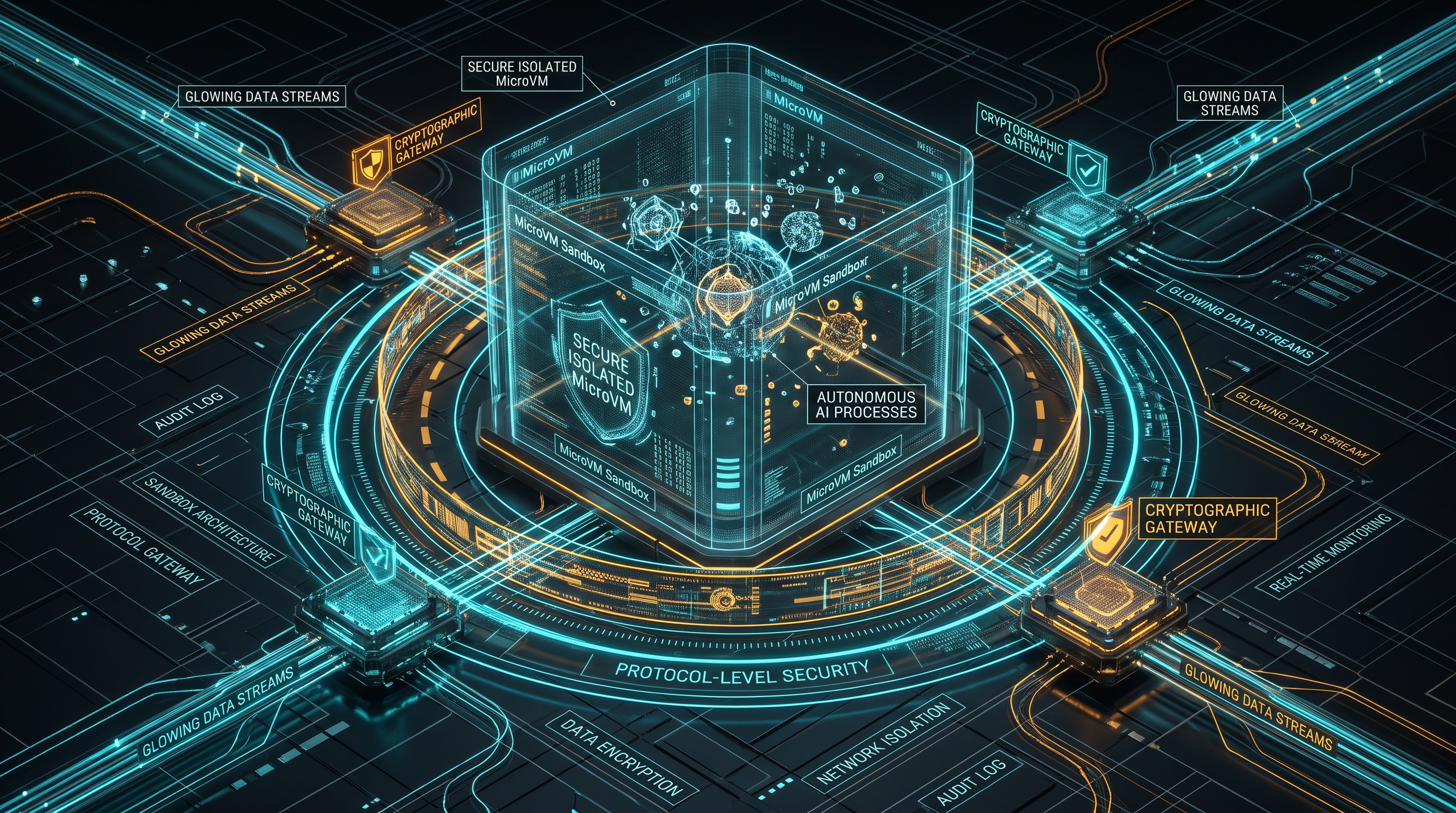
To build agents suitable for enterprise deployment, forward-looking engineering teams are adopting protocol-level isolation. Rather than hoping the model respects semantic instructions, teams isolate the model behind strict execution contracts.
A. MicroVM and Ephemeral Container Sandboxes
When agents execute code or interact with files, each session should spin up an isolated, short-lived microVM (e.g., Firecracker or gVisor) with:
Strictly scoped outbound network access (domain allowlisting only).
Ephemeral read-write volumes destroyed after task completion.
Resource caps preventing CPU/memory exhaustion attacks.
B. The Model Context Protocol (MCP) Standard
Emerging open protocols like Anthropic's Model Context Protocol (MCP) provide a clean abstraction for decoupling reasoning from direct resource access:
Client-Server Boundaries: Agents interact with MCP servers that expose explicitly defined tools and resources via deterministic schemas.
Granular Scoping: Permissions are granted per tool, per resource, and per session—meaning an agent querying support tickets cannot even discover database administration tools.
🛠️ Ready to test isolated tool execution?
Explore the AIMates Build Workspace to experiment with pre-configured Model Context Protocol (MCP) servers, sandboxed agent tools, and structured JSON contracts without exposing your production infrastructure.
3. The Enterprise Architecture
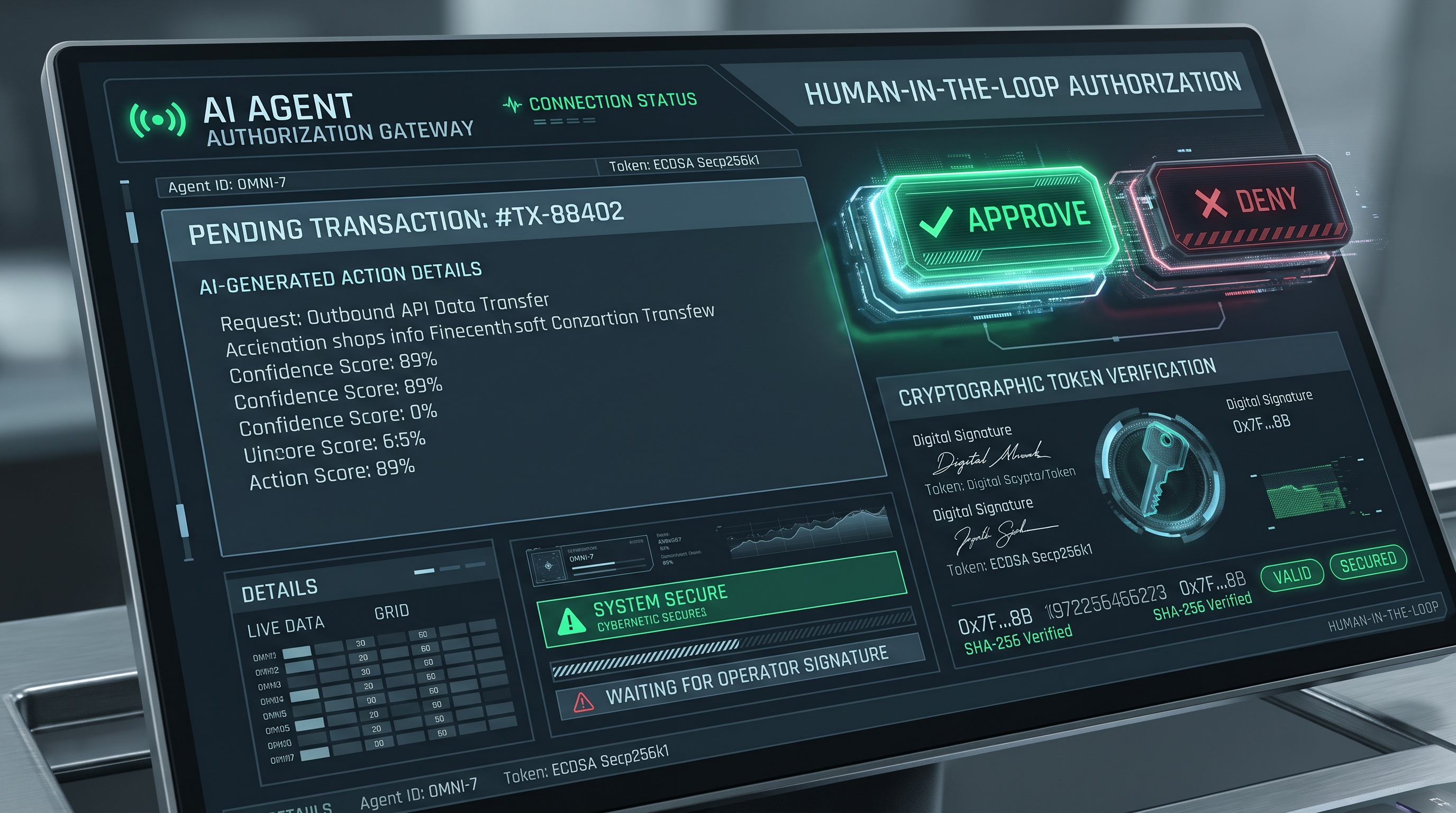
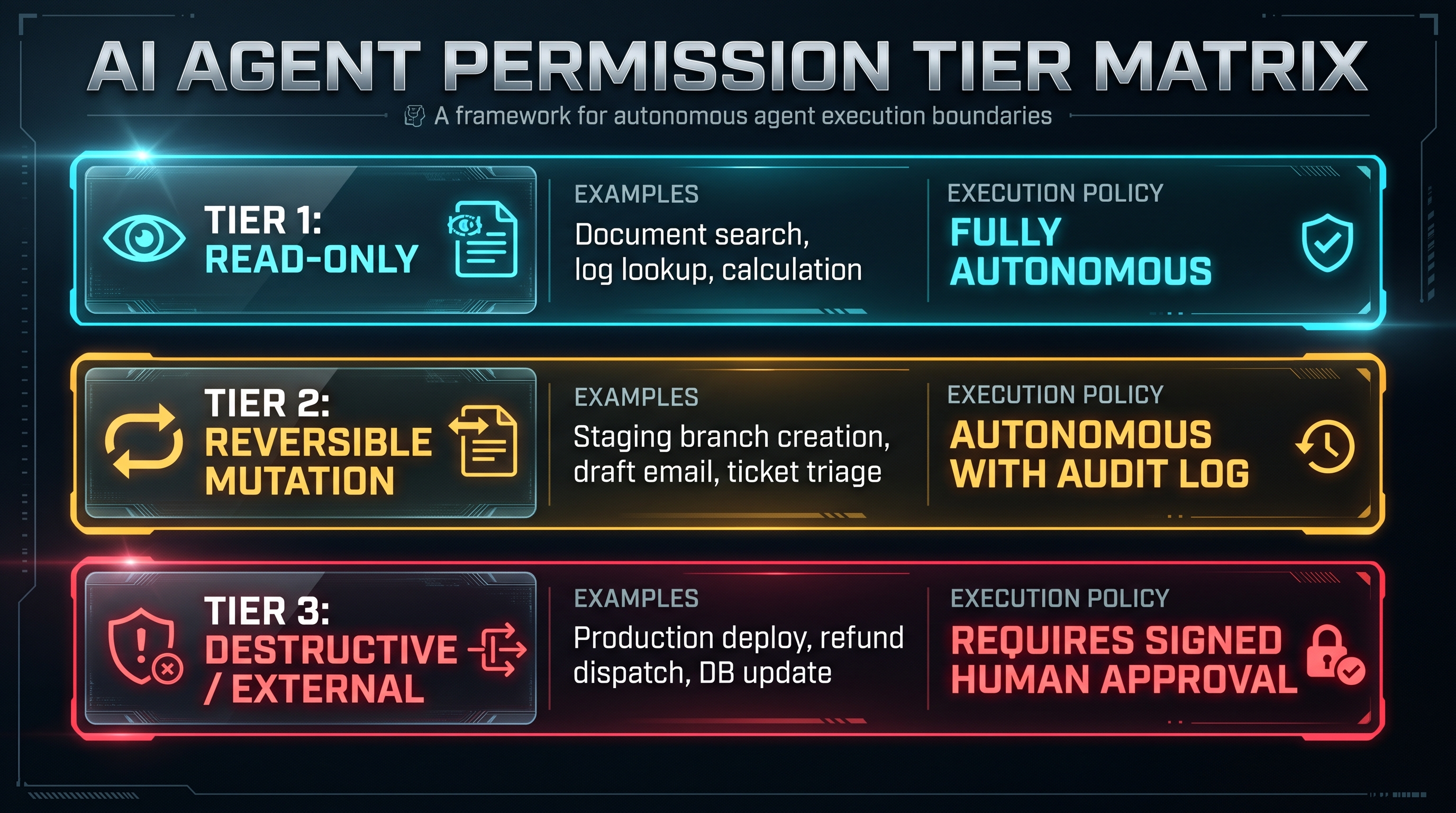
Autonomous systems do not have to be binary (fully manual vs. completely unsupervised). Production-ready architectures implement staged permission tiers:
Risk TierExamplesExecution Policy
📖 Deep Dive: Want step-by-step guides on wiring approval webhooks and token verification? Check out our hands-on tutorials in AIMates Learn covering zero-trust agent integration and enterprise LLMOps workflows.
Implementing Step-Up Verification
When an agent determines a Tier 3 action is necessary, the runtime engine intercepts the tool call:
The agent generates a structured proposal (e.g.,
IssueRefund(userID, amount, reason)).The runtime halts execution and dispatches an interactive approval card to Slack or an internal dashboard.
An authorized human signs off with standard SSO/MFA credentials.
Only upon receipt of the signed verification token does the runtime forward the payload to the downstream API.
Conclusion: Engineering Beyond the Prompt
The transition from AI toys to mission-critical infrastructure demands treating agent architectures with the same rigor applied to distributed systems and zero-trust networks:
Assume prompt compromise is inevitable.
Never grant raw administrative credentials to an LLM runtime.
Enforce deterministic authorization filters between the model output and external systems.
Once we stop asking prompts to do the job of a firewall, autonomous agents can finally achieve safe, scalable enterprise adoption.